
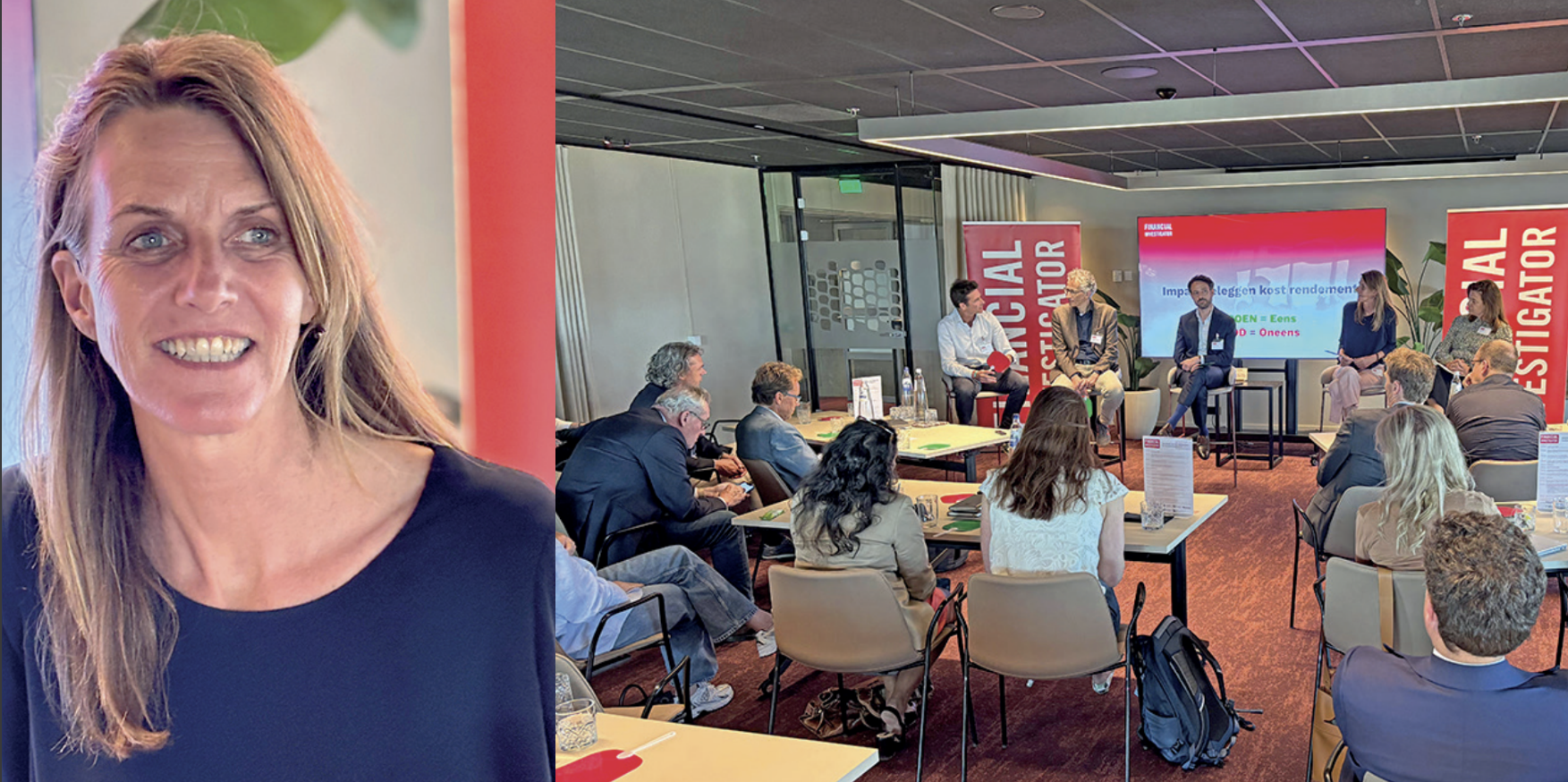
Marlene Stam | Where Impact Makes the Biggest Difference
Marlene Stam recently joined a panel of impact investors including representatives from BlackRock, Blink Impact, Impact Orange Partners, and Anthos Fund & Asset Management at a Financial Investigator seminar on impact investing in private markets for family offices. The discussion opened with a provocative proposition: that impact investing comes at the cost of return. Most of the room disagreed with the premise outright, but the panel’s conversation that followed was more nuanced than the opening vote suggested, the panelists agreed that feasibility depends heavily on theme, asset class, time horizon, and manager selection, rather than on any blanket rule.
A market that has grown up
Drawing on fifteen years in the field, Marlene described just how far the opportunity set has come.
“When I first came into contact with impact investing fifteen years ago, it was mainly about financial inclusion and healthcare. If you look now, that market has grown enormously.”
Numerous specialized impact funds have since emerged around themes like climate, food systems, oceans, education, and healthcare, with private debt now developing as a growing impact instrument alongside them.
But growth hasn’t been even across themes, she cautioned, and that unevenness has real consequences for how investors should approach the space.
“Oceans are a fantastic theme, but worldwide there are maybe five or six specialists that are genuinely interesting for Dutch investors.”
For Marlene, that gap between enthusiasm and available expertise is exactly why impact investing increasingly rewards deep market knowledge, disciplined selection, and genuine market insight. Not every theme offers the same scale, track record, or number of specialized managers to choose from.
Different investors, different entry points
Marlene also pointed out that the appeal of a given impact theme often tracks the type of investor behind it.
“Many families are drawn to later-stage venture capital because of the innovation, entrepreneurship, and the chance to support new solutions at a relatively early stage. Institutional investors focus more often on growth capital, infrastructure, and real-assets strategies that can roll out proven solutions at greater scale.”
The question that comes before the investment
Perhaps the most resonant idea Marlene brought to the discussion was a reframing of where impact strategy should actually begin. “Before you even start investing, you need to think carefully about the role you want to play as an investor.” Some families choose to focus independently on a particular theme with which they have great affinity. Others partner with specific knowledge institutions, foundations or public organizations, or fellow families and others concentrate on scaling solutions across one or more relevant themes that already work. As Marlene put it to the room: “Do you want to create direct impact and see tangible results? Or do you want your capital to broaden systemic change?”
That question of role, Marlene argued, is where some of the most interesting opportunities for impact investors lie. Not necessarily in the largest or most visible transactions, but in the ones where capital can be genuinely catalytic.
“You can also choose to be catalytic. Sometimes you can make a greater difference by helping smaller funds or emerging strategies to grow in an earlier stage than by joining a established fund everyone is already invested in.”
There is no right or wrong choice; what matters is choosing the role that best reflects who you are, what you care about and the impact you want your capital to create and then building your investment strategy around it.
Key takeaways from the roundtable
Beyond Marlene’s contributions, the panel surfaced several broader conclusions about where impact investing in private markets stands today:
- Impact and return don’t inherently exclude each other. Feasibility depends strongly on theme, asset class, time horizon, and chosen manager.
- Additionality is becoming increasingly central: investors are looking for places where capital genuinely adds something that otherwise wouldn’t have happened.
- Impact objectives require a clear theory of change: measurable goals matter but so does room for tailoring and flexibility to avoid screening out investments that don’t fit a standard model.
- The market is growing but unevenly. The supply of impact investments is growing fast, but requires specialist knowledge and careful selection to navigate emerging sectors.
- Emerging markets often offer more impact opportunities. Capital deployed in these markets can often generate more additionality than if deployed in developed markets due to greater capital needs.
This panel was reported on by Financial Investigator (Issue 5, 2026). Quotes have been translated from the original Dutch publication, which can be read here.